 En
En
Professional perforated metal sheet supplier
Let’s be direct: if you’re sourcing perforated metal sheets, you’ve likely felt the sting of price hikes, missed deadlines, and inconsistent quality. The traditional supply chain is crowded with middlemen, each adding a markup and a layer of miscommunication. It’s inefficient.
We’re here to cut through the noise. As a professional supplier, Hengai Metal operates differently—as a true end-point factory. We control the entire process from raw coil to finished, ready-to-install component. This isn't just about selling a product; it's about engineering a more cost-effective and reliable supply chain for your projects.
Here’s how we break down the costs and build up your bottom line, backed by real industry comparisons and actionable strategies.
1. Why "Price per Sheet" Is Misleading: The Real Cost of Multi-Layer Sourcing
When you buy from a trading company or distributor, you’re not just paying for the metal. You’re paying for their overhead, their profit margin, and the logistics of moving goods between multiple warehouses. A common scenario we see involves a client sourcing punched panels from one supplier, sending them to another for bending, and a third for welding. Each step incurs freight costs, handling fees, and potential damage risk.
Consider this: A major project sourcing through a traditional distributor often sees a 15-20% price premium compared to direct factory pricing. With complex components involving multiple processes, that margin can skyrocket due to coordination waste and rework.
The Hengai Metal Advantage: We are a terminal factory. Our production line includes perforating presses, turret punch presses, laser cutting machines, bending machines, and welding stations. This comprehensive capability means your project doesn’t travel. You deal with one point of contact, one quality standard, and one invoice.
Actionable Tip: Request a "Process Map" from your supplier. Ask them to list each step of production and whether it's done in-house or subcontracted. If the majority is subcontracted, question the cost breakdown closely. A true factory can provide a transparent, itemized cost based on their own machinery and labor, eliminating hidden third-party fees.
2. The Hidden Cost of Inconsistent Quality: How In-House Production Saves You Twice
We’ve all heard the saying, "It’s expensive to be cheap." In perforated metal, never is this truer. Inconsistent hole placement, excessive burrs, or dimensional drift on a sheet can cause catastrophic issues downstream. Auto parts fail to assemble, acoustic panels don't align, and filtration systems leak.
Distributors who outsource production have little control over these variables. They rely on third-party shops where your order is just one of many, often scheduled for convenience, not for quality.
The Real-World Cost: A single rejected batch of perforated screens for a mining application not only costs you the price of the material but also the expensive downtime in your own production line.
The Hengai Metal Advantage: Our full-fledged, in-house production ensures every sheet passes through a rigorous internal quality inspection protocol. We can trace any quality issue back to our specific machines and operators. This traceability allows us to maintain a defect rate far below industry averages, ensuring your production lines stay operational. By sending us your flat sheets for punching and your punched blanks for bending and welding, you are buying peace of mind and a seamless workflow.
Actionable Tip: Ask your supplier for a detailed Quality Assurance (QA) plan before placing an order. How do they measure hole diameter post-punching? What is their process for handling burr removal on the exit side? Our team is happy to share our specific QA checkpoints and tolerance standards upfront.
3. Combating Supply Chain Inefficiency: The Power of One-Stop Fabrication
Time is your most valuable currency. Sending a part out for multiple processes across different vendors is a logistical nightmare. Each transition involves packaging, transportation (with its own carbon footprint and cost), and a delay for scheduling at the next facility. If a part is bent incorrectly after being punched, the finger-pointing between vendors can stall your project for weeks.
The Statistical Reality: Studies have shown that inter-factory logistics can add 2-3 days of lead time for each process step. If your design requires 4 different processes, that's potentially 12 days lost to transport alone—not production.
The Hengai Metal Advantage: Our facility is designed to eliminate this waste. We can take a flat sheet of stainless steel, punch it with a custom pattern, laser-cut the perimeter to your exact blueprint, and then form it into a filter drum or an acoustic enclosure—all in one continuous production flow. This approach reduces your total lead time and eliminates the risk of miscommunication between vendors. We boast a complete spectrum of services, from material selection advice to surface finishing (powder coating, anodizing) and final packaging.
Actionable Tip: When designing your next component, send the entire assembly drawing to our [Hengai Metal] engineering team. Rather than pricing just the perforated flat sheet, ask for a quote on the complete finished component, including bends, welds, and hardware. You'll often find that we can supply a ready-to-install part for a total cost that is lower than the sum of your previous multi-vendor purchases.
4. Overcoming the "Small Order" Barrier: How We Prototype for Scale
In the past, small-batch prototypes were the bane of a factory’s existence. They disrupt production runs and generate minimal revenue. Many suppliers actively avoid them, forcing buyers to pay exorbitant prices or wait for months for a "free" sample that fits into a larger scheduled run.
This approach stifles innovation. You shouldn't have to commit to 1,000 sheets to test a new acoustic panel design.
Our Competitive Edge: We support OEM/ODM projects and we welcome initial trial orders. Our flexible production scheduling allows us to handle single-digit sheet counts or dozens of small components efficiently. Many of our long-term partnerships began with a sample order of just a few dozen pieces. By treating these trial runs with the same urgency and quality as mass production, we help you get your product to market faster.
Actionable Tip: Use a prototype phase to test not only the aesthetics but the actual fabrication. Use the trial order to verify our capacity to handle your custom specs (e.g., specific hole patterns like staggered hexagonal or micro-perforations) and rigorous tolerance requirements. This process builds confidence before you scale up to a high-volume, long-term agreement.
5. Beyond the Punching: Unlocking Value with Surface and Finishing Services
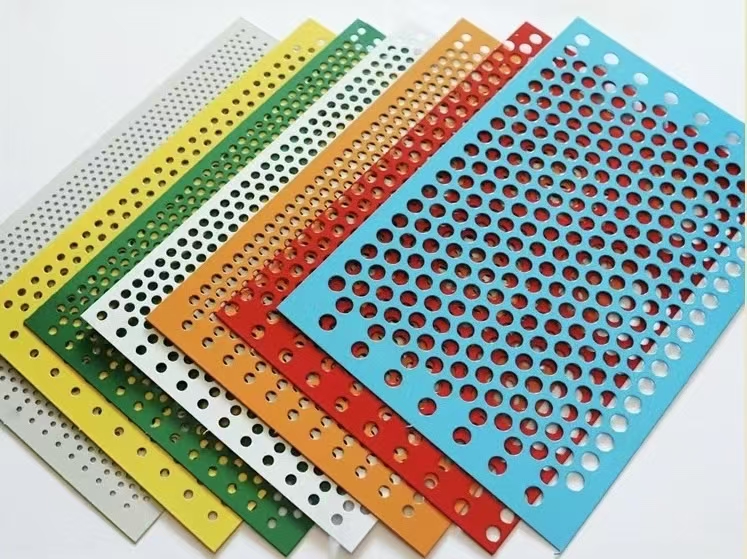
The perforation is just the beginning. The real cost and value of your part often lie in the surface treatment. A raw punched carbon steel sheet will rust. A high-quality powder-coated or galvanized panel will last for decades.
If your supplier is purely a "hole puncher," they will send your parts to a specialty coater. This introduces not only additional cost but also a significant liability—if the coating is damaged during freight, who is responsible?
The Technical Difference: Our in-house capabilities include various finishing processes such as powder coating, zinc plating, and brushing. This ensures the surface treatment is applied correctly to the punched holes’ edges—the most critical and vulnerable part of the sheet.
Actionable Tip: Inquire about the supplier’s finishing capabilities. Getting your punch-out metal including custom fabrication and a protective finish from a single source can often reduce your overall procurement costs by 5-10%, simply by eliminating the packaging and transportation costs associated with moving parts to a separate finisher.
6. Case Study: From Inefficiency to Integration
To illustrate these points, let's look at a typical client scenario we encounter.
The Client: A manufacturer of industrial filtration systems. They were sourcing their cylindrical filter cores (perforated metal, rolled and welded) through a complex supply chain. They purchased perforated flat sheets from Supplier A, had them rolled and welded by Supplier B, and sourced the end caps from Supplier C.
The Problem: The company was losing 15% of its profit margin to logistics, and 6% of its production schedule was wasted on rework due to alignment issues between the perforation pattern and the welded seams.
The Solution with Hengai Metal: They transitioned to our [Hengai Metal] team. We now manufacture the entire filter core assembly. We select the appropriate stainless steel grade, optimize the hole pattern for flow rate, punch and roll the body, weld it with precision, and fabricate the end caps. This single-sourcing strategy eliminated freight costs between Suppliers A, B, and C, reduced their inventory holding costs, and ensured dimensional accuracy.
The Result: The client saw a 12-15% reduction in overall part cost and significantly reduced assembly time in their own facility.
Conclusion: Your Bottom Line Matters
The cost of perforated metal isn't just on the invoice for the perforated metal itself. It’s the hidden costs of logistics, quality control, and project management. We believe that the smartest way to save money is to simplify your supply chain and partner with a professional terminal factory.
At Hengai Metal, we are committed to transparency, to delivering high-quality products with full traceability, and to helping you find material solutions that meet your budget. We invite you to challenge us with your most complex or seemingly small order, and see how we turn your sourcing strategy into a competitive advantage.