En
En
Perforated metal sheet with best performance
Choosing the right perforated metal sheet is rarely about finding a single "best" product. It's about finding the best match for your specific application. A sheet perfect for architectural facades might fail within months in a heavy-industrial screening environment. Understanding the key performance drivers can save you significant time, cost, and operational headaches.
Why Performance Varies More Than You Think
Many buyers assume perforated metal is a commodity product. They compare price per square foot, pick the lowest quote, and hope for the best. That approach often backfires.
The harsh reality: performance differences come down to material selection, hole geometry, manufacturing tolerances, and finishing quality. A cheap sheet and a premium sheet may look identical in photos, but their lifespan, structural integrity, and functional efficiency can differ by three to five times.
Consider this data point: in acoustic applications, changing open area from just 20% to 30% can improve sound absorption coefficients by up to 40%. But the same 10% increase in open area reduces structural strength by roughly 15-20%. That's why design expertise matters—every decision involves tradeoffs.
Key Factors That Determine Real-World Performance
Forget generic rankings. Here are the specific criteria you should evaluate before selecting a perforated metal supplier or product specification:
Long-Term Durability and Corrosion Resistance
The biggest risk to a perforated metal installation isn't poor holes—it's premature rust or degradation. This is especially true in outdoor, coastal, or high-humidity environments.
Stainless steel grades like 304 and 316 offer excellent corrosion resistance. Aluminum provides natural oxide protection at lower weight. For indoor industrial applications, galvanized steel offers decent performance at a budget-friendly price point.
However, performance changes dramatically after perforation. Cut edges expose non-protected material. Proper surface treatment is not optional—it's a critical investment. For outdoor use, options like powder coating or PVDF paint seal those raw edges. For food processing or pharmaceutical settings, electropolishing ensures hygiene and cleanability.
For environments where exposure is severe, expect to pay a 20-40% premium for a higher material grade—yet it eliminates the cost of premature replacement, which can be 5-10 times the original purchase price when factoring in labor and downtime.
Precision of Hole Pattern and Open Area
The hole pattern directly impacts airflow, screening efficiency, weight, and aesthetics.
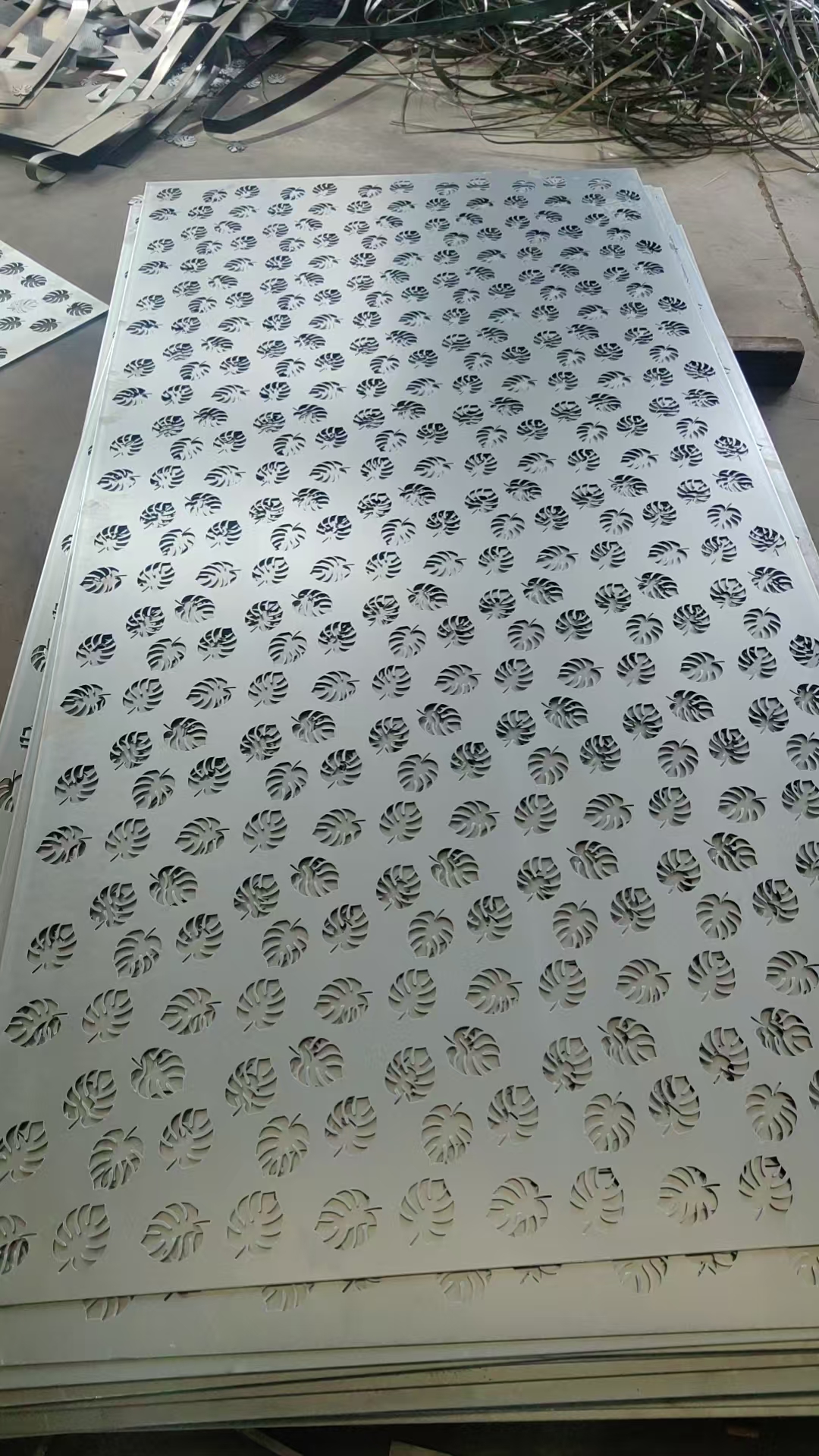
Common patterns include round, square, slotted (elongated), hexagonal, and decorative custom shapes. Round holes offer the best structural integrity relative to open area. Slotted holes maximize open area for light and airflow while retaining good formability. Hexagonal holes provide excellent strength under heavy loads.
Performance matters most here: For screening and filtration, consistent hole dimensions directly dictate product recovery rates. In mineral processing, even a small variation in hole diameter can lead to poor separation quality and material waste. High-quality suppliers use CNC-controlled punching machines, achieving hole diameter tolerances of ±0.1mm or better. Cheaper equipment may produce tapered holes or edge deformation, compromising downstream processes.
Open area calculation is another hot topic. It must align with structural requirements, deflection tolerances, and material thickness. As a general guideline, for structural applications keep open area below 45%; if airflow or visibility is the priority, target 50-60% and account for reduced load-bearing capability.
Manufacturing Accuracy and Burr Elimination
Here is a hidden problem buyer miss until installation: inconsistent flatness and sharp burrs.
When sheets aren't perfectly flat, they don't sit well in frames, creating safety hazards and ruining aesthetics. Burrs cause injuries to installers and erode coatings over time. High-quality suppliers flatten panels post-punching and perform deburring passes. This attention to detail extends walkway grating lifespan by 2-3 times and maintains architectural finish integrity.
One of our global manufacturing facility partners, Tianjin Hengai Metal Product Co., Ltd., takes precision seriously. They operate full production lines—CNC turret punching, laser cutting, press braking, and welding—all in-house. By eliminating outsourced intermediate steps, they keep tolerance accuracy tight and quality traceable for every batch, which directly translates to predictable performance.
Resistance to Deformation and Fatigue
A perforated sheet in constant motion (like a vibrating screen or moving guard) is susceptible to fatigue at hole edges. When hole spacing is too tight relative to material thickness, microscopic cracks can develop and expand.
Rule of thumb: the distance between hole edges must be at least 1.5 to 2 times the material thickness. This helps distribute stress evenly and prevents premature failure.
For dynamic loading situations, your supplier should recommend high-cycle durable materials like spring steel or hardened stainless steels. CNC punching maintains its integrity by avoiding micro-fractures that shearing or burning can cause.
Deep Dive: Perforated Metal for Specific Industries
Each sector presents distinct performance priorities. Here's how to evaluate your key metrics.
Industrial: Mining, Filtration, and Equipment Protection
Advanced screening solutions demand steel that handles abrasive material and heavy impact without bending. Wear life matters more than initial cost. Typically, thicker sheets—2mm to 8mm—with smaller holes and larger materials are used for high-impact wear resistance. A safe performance benchmark for mining screens is ore throughput of over 150 tons per hour per square meter at a separation efficiency of 90% or above.
Hengai Metal supplies specialized screening plate for mining operations. By choosing proper heat-treatment and a hard-wearing material like abrasion-resistant steel or spring steel, they've helped industrial clients increase service intervals by 40%. One example involved a customer previously purchasing imported screens that lasted three months. An optimized design using local AR plate lasted 5 months, reducing cost per processed ton by 60%.
Ventilation components benefit from lower weight and smooth airflow properties. Using high open area (about 50%) with long slot holes on aluminum sheets maintains the required airflow at a fraction of the weight of steel. For equipment guards, slotted or square hole options can carry specific machine safety ratings.
Architectural: Facades, Ceilings, and Interior Design
Visual consistency and durability rule here. The architect's vision depends on the predictability of the pattern—uniformity across multiple panels creates a seamless appearance.
Flatness is a must. If sheets are even slightly bowed, their reflection of light becomes inconsistent, ruining the facade effect. High quality guaranteed flatteners can deliver the required flatness tolerance.
Environmental resilience is discussed earlier—consider high-quality PVDF coatings, which last 20+ years without fading or chalking.
For large-scale buildings, another performance factor comes in: security and safety. Does the sheet have adequate structural strength to act as a fall prevention barrier? In many cases, 1.5mm stainless solid panels are perforated. Regular quality checks ensure no compromise of the material capability.
If your project involves curved facades or complex geometry, pick a supplier that can pre-curve or stretch-form the material with appropriate notching. Standard flat products will not deliver the desired performance in these installations.
Filtration and Acoustic Solutions
Micro-perforated panels (with hole diameters from 0.5mm to 3mm) provide sound absorption and filtration. The pain point? Manufacturing these sheets without burrs blocking holes requires precise control.
Key properties:
Perforation pattern structure with uniformity in distribution across the material.For filtration, a clean cut edge prevents material buildup and clogging.
Case study: In the automotive industry, replacing fiberglass batt with perforated films in muffler internals took mass production from 100% rejection down to under 2% due to cleaner cutting with no burrs. Those are silent performance wins, but crucial profit drivers for plant manufacturing.
Heavy-Duty Protection: Guards and Screens
Use of custom guards is a critical safety requirement, but poorly manufactured guards introduce new safety risks. Excessive sharp edges, weak fastening, and lack of round-hole designs all contribute to workplace accidents.
In this domain, conformance to safety standards (such as hand protection standards for industrial machinery) must be strict. Each guard has specified maximum holes to prohibit finger access, while still allowing visibility and airflow.
A balanced sheet for these uses often falls between 1mm and 2mm thick, with the hole aspect ratio optimized per protection level.
How to Compare Suppliers for Performance
It's difficult to measure "performance" in a lab vacuum. The best approach is rigorous supplier vetting.
1. Demand Physical Samples
Ask for samples in your specific material grade, thickness, and hole pattern. Handle them, measure them, try to bend them. Confirm thickness accuracy using calipers.
2. Ask Technical Questions
Probe beyond sales talk.
How do you manage flatness post-punching?
What edge condition can we expect—burr-free, deburred, etc.?
Can you guarantee the production lead time contractually?
3. Inquire About Faulty Batch Policies
Quality manufacturers test their output and supply test certificates. Check their quality management strategy. A warranty against defective materials and workmanship signals their confidence and helps protect your bottom line.
4. Check Their Full Production Process
A "reseller" can only quote prices and forward your order to unknown factories. A robust performer owns the factory and controls quality at every step.
For example, Tianjin Hengai Metal Products is a dedicated factory. It holds its production chain fully, from raw material inventory through stamping, CNC, welding, surface finishing, to packaging. This kind of end-to-end capability is your best partner regarding performance and delivery: they mitigate the greatest risks of human error and scheduling delays brought by outsourcing.
5. Evaluate Their Customization Labor
Does your supplier offer design help? Or do they stick to catalogs?
Real performance customization arises in the flexibility of multiple materials and the capability to modify hole types to application-specific needs. Companies that provide custom hole patterns and prototype quickly will help you optimize your design in much less time.
For example, at Hengai Metal, they support OEM and ODM projects, producing from customer drawings or samples, even suggesting cost-effective material alternatives. Their line of perforated filter cylinders, protective sleeves, acoustic panels, and air vents is evidence of engineering support beyond commodity supply.
Practical Advice for Your Next Procurement
Develop a Full Specification Before You Buy. Include the following details to avoid surprises:
Alloy and temper of the metalHole type, diameter, center-to-center spacing
Open area percentage
Panel dimensions (length, width, thickness)
Edge conditions
Tolerance requirements (flattening, hole deviation)
Surface treatment
Quantity and required certifications
The clarity prevents ambiguity and lets you compare quotes on an equal footing.
Consider Life-Cycle Cost Over Initial Price. When you calculate the cost of frequent change-outs, poor product yield, or an installation needing replacement earlier than expected, it's clear a cheap sheet is often the priciest. Pay up-front for quality.
Get Sample Approvals. Whenever possible, have your engineering team approve samples before authorizing full production.
Build Long-Term Partnerships. Instead of spot-purchasing from whoever is cheapest this month, work with one or two trusted suppliers. Keep ongoing and deeper technical discussions, which often unlock supplier-driven innovations, better stock availability, volume discounts, and priority production slots.
The Bottom Line on Perforated Metal Sheet Performance
The "best" perforated metal sheet is a precise combination of properties—corrosion resistance, fatigue strength, pattern accuracy, edge quality, and relevant surface finishes—aligned with your application's demands. Ultimately, the supplier's manufacturing capability and honesty determine the performance you receive. When seeking reliability and performance, don't hesitate to consider a direct, factory-based source like Hengai Metal, which combines manufacturing controls and cost transparency with custom fabrication expertise.
A strategically selected perforated metal sheet is more than a functional component. It's a durable investment in your product’s efficiency, lifespan, and even its design appeal. Invest the extra time upfront to get it right. That's how you achieve optimum performance.